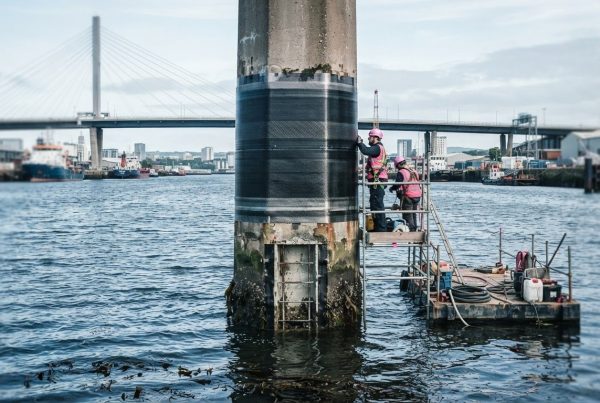

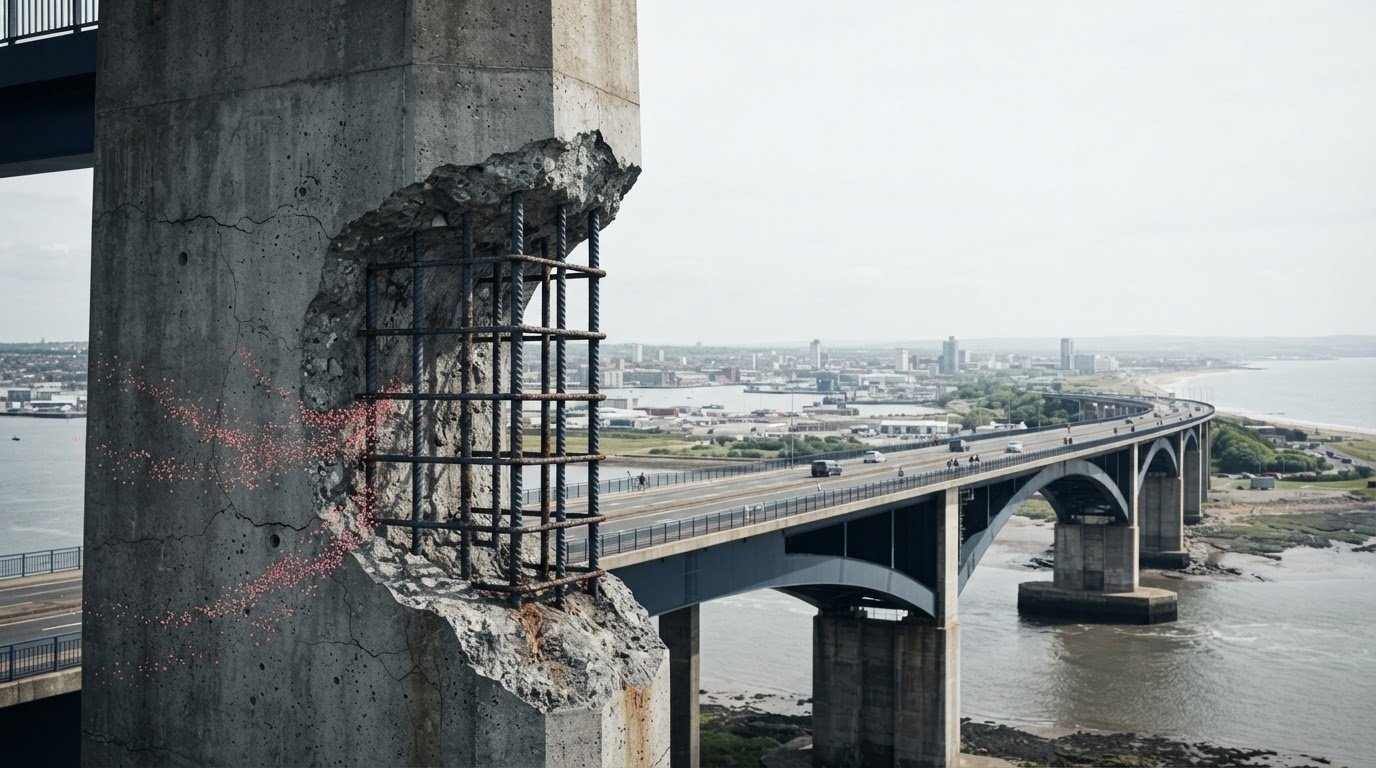
Chloride attack on reinforced concrete can begin before visible damage appears: chloride ions reach the steel and, at a critical concentration, can initiate reinforcement corrosion. BS EN 206-1:2013 gives a critical chloride content of 0.4% by weight of cement for reinforced concrete and 0.1% for prestressed concrete. Concrete cover helps protect the reinforcement by lengthening the route chlorides must travel.
Rust staining, cracking and spalling are important warning signs, but their absence does not necessarily mean the reinforcement is protected. Dense, high-strength concrete can conceal damage until symptoms become visible, so exposure conditions, chloride movement and cover depth are central to assessing risk.
This article explains what chloride contamination is, how chlorides enter concrete through pores and cracks, and how binding affects the amount available to reach the steel. It also explores how chloride thresholds and concrete cover affect reinforcement protection, helping you understand why deterioration can develop gradually.
Key Takeaways
- Chlorides can reach embedded steel and trigger corrosion, with damage sometimes developing before clear surface symptoms appear.
- Moisture, surface cracks and repeated wetting and drying can influence how chlorides move through concrete.
- Chloride thresholds differ between reinforced and prestressed concrete; binding also affects how much chloride remains available to reach the steel.
- Concrete cover forms part of the reinforcement’s protection, so exposure conditions and the concrete’s condition matter when assessing risk.
What is Chloride contamination?
Chloride contamination occurs when chloride ions accumulate in concrete, putting embedded reinforcement at risk. In marine structures and road bridges exposed to de-icing salts, these ions can reach the steel and initiate corrosion.
Corrosion of reinforcing steel
Chloride-induced corrosion begins when chloride ions at the reinforcement disrupt the passive oxide layer protecting the steel. This matters because corrosion products occupy more space than the original steel, placing pressure on the surrounding concrete. Oxygen and water at the cathode allow the oxidation reaction to continue at the anode. Chlorides have little effect on hardened concrete itself, but can undermine the reinforcement’s protection.
Surface damage and corrosion acceleration
Surface damage, such as abrasions, cavities and impact cracks, can create faster routes for moisture and chloride ions. This shortens the path to the reinforcement and can bring corrosive conditions closer to the steel. As corrosion progresses, cracks often form along the reinforcement, followed by rust staining or concrete spalling. These signs point to damage within the concrete cover, not merely a cosmetic surface defect.
Exposure is not limited to the shoreline: concrete structures as far as 2 km inland from coasts can be affected. Seawater exposes sea walls to chloride ions, whilst de-icing salts can affect road bridges, car parks and underground structures. Contaminated aggregates, water or admixtures can also introduce chlorides during construction.
Efflorescence on a concrete surface may indicate chloride contamination before severe corrosion becomes visible. However, contamination often becomes apparent only after rust staining, corrosion cracks or spalling develop. Where concrete has spalled, exposed reinforcement may show pitting and dark corrosion products, helping distinguish steel deterioration from isolated surface wear.
Repair and corrosion-control methods include concrete replacement, chloride extraction and cathodic protection. Corrosion inhibitors and concrete or hydrophobic impregnation can also address contaminated concrete or limit further ingress. Each method works differently: replacement removes affected material, while cathodic protection controls corrosion activity. The appropriate approach depends on the damage mechanism and the condition of the concrete and reinforcement.
Chloride ingress through concrete pores
Chloride ions enter concrete through pores, micropores and surface cracks, carried by moisture or diffusion. In the United Kingdom, common sources include marine exposure and winter de-icing salts.
Chloride sources
Chloride sources include seawater, de-icing salts and contaminated construction materials. In winter, salt-laden water from treated roads can reach adjoining concrete, while marine structures are directly exposed to seawater. Aggregates, mixing water and admixtures can also introduce chlorides during production. Identifying the source matters because repeated exposure, moisture and concrete condition influence whether ions continue moving towards embedded reinforcement.
Mix design to reduce ingress
Mix design can reduce ingress by limiting concrete permeability and connected pore pathways. A low water-to-cement ratio, adequate compaction and sufficiently long wet curing help produce denser concrete. Fly ash, blast-furnace slag and silica fume can also reduce chloride penetrability. These measures work together: mix proportions influence pore structure, while compaction and curing affect the condition of the hardened concrete.
Once chloride-bearing moisture reaches the surface, capillary action can draw it through pores and micropores. Chloride ions also move by diffusion through water in the concrete, or through cracks that bypass some of the protective cover. Repeated wetting and drying can increase penetration: salts enter during wet periods and become concentrated as moisture evaporates.
Pore size and connectivity affect how readily water or vapour is absorbed and transported. Smaller, less-connected pores slow that movement, although surface cracks can provide a more direct route. Concrete Society Technical Report 61 covers measures for improving resistance to chloride ingress and methods for modelling its rate. These factors help explain why exposure alone cannot describe the ingress risk: transport also depends on the concrete’s mix and physical condition.
Chloride thresholds and binding
A chloride threshold is the concentration at which corrosion may begin at embedded steel. Interpreting this value requires attention to both chloride content and concrete chemistry.
Chloride limits and corrosion thresholds
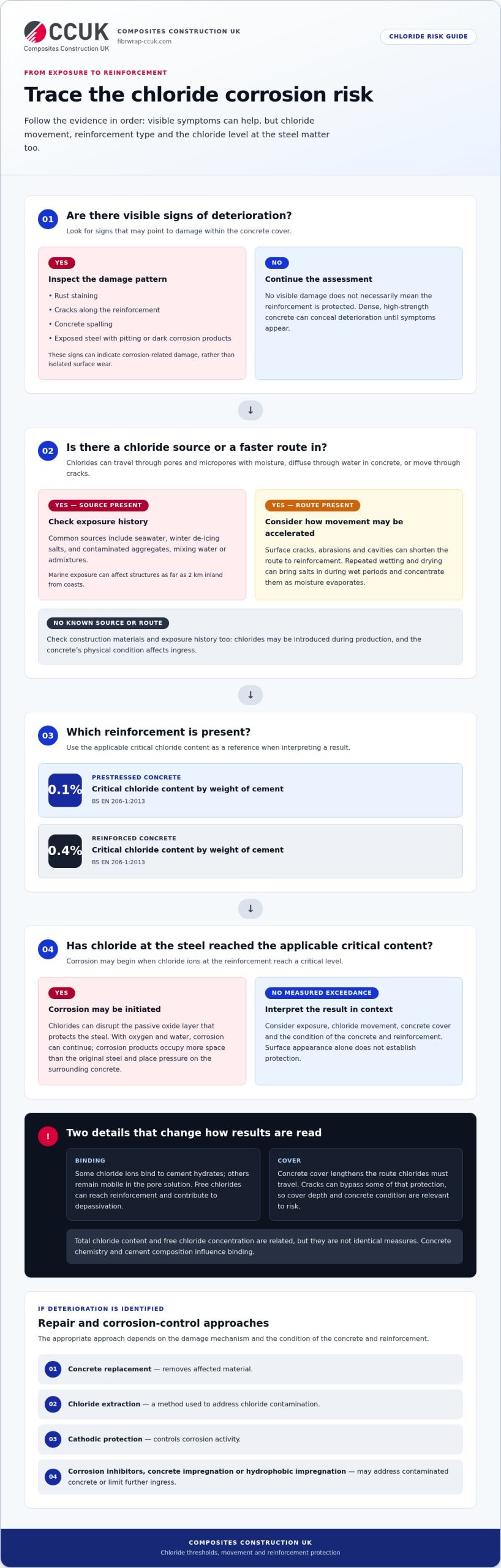
In the United Kingdom, BS EN 206-1:2013 gives critical chloride contents of 0.4% by weight of cement for reinforced concrete and 0.1% for prestressed concrete. BRE Digest 444 provides a more comprehensive interpretation of factors involved in chloride-induced corrosion. These references help frame assessment, but a measured concentration must be considered alongside exposure and the reinforcement type.
The threshold matters because corrosion can begin once chloride ions at the steel reach a critical level. For a marine structure or a prestressed element, chloride results should therefore be interpreted against the applicable threshold, rather than assessed by surface appearance alone.
Chloride binding in concrete
Chloride binding occurs when some chloride ions associate with cement hydrates, while others remain mobile in the pore solution. This distinction matters because mobile, or free, chlorides can reach reinforcement and contribute to depassivation.
Total chloride content and free chloride concentration are related but not identical measures. Cement composition and concrete chemistry influence how much chloride is bound; changes in these conditions can alter the fraction available to move. Binding does not remove chloride from the structure, so it is not a substitute for assessing corrosion risk.
Measuring chloride content
Chloride content in concrete is assessed by collecting samples and analysing their chloride concentration. Samples taken at different depths show how levels vary from the surface towards the reinforcement. The results can then be compared with the applicable threshold, expressed by weight of cement.
Sampling location and depth matter: a surface result alone may not represent the concentration at the embedded steel. Assessment also considers whether the reported value represents total or free chloride, the reinforcement type and exposure conditions. For a marine structure, these details help distinguish chloride near the surface from contamination that has reached reinforcement depth.
Concrete cover and reinforcement protection
Concrete cover is the layer between the surface and embedded reinforcement, forming a barrier against chloride ingress. Its protective value depends on depth, concrete quality and exposure. BS 8500 defines concrete mix design and gives requirements for cover; the cited edition is BS 8500:2015+A1:2016. Cover is therefore designed in relation to the structure’s exposure, rather than treated as a universal dimension.
Increasing cover depth in line with environmental exposure conditions can lengthen the path chloride-bearing moisture must travel. This supports reinforcement protection, particularly in marine environments or areas exposed to de-icing salts. However, cover cannot be considered in isolation: cracks, poor compaction or permeable concrete can create pathways that reduce its effectiveness. Durability depends on the interaction between cover, material condition and exposure.
Surface condition also affects how well the concrete cover performs. A crack or local defect can let moisture and chlorides bypass sound concrete, bringing them closer to the steel. Dense, high-strength concrete presents a particular assessment challenge: reinforcement damage may develop without obvious symptoms until substantial steel loss has occurred. An intact-looking surface does not, by itself, prove that the steel remains protected.
Surface coatings can act as a barrier to chloride ingress into concrete and towards embedded reinforcement. They complement, rather than replace, suitable cover and durable concrete. For existing structures, assessment should consider exposure, visible cracking or spalling, and whether damage may have reached the reinforcement. These factors help distinguish a surface defect from deterioration that requires intervention.
The practical takeaway is to assess cover as part of the whole protection system: exposure, concrete quality, surface condition and reinforcement condition all matter. For structures requiring design-led strengthening or repair, review structural design considerations alongside the condition assessment, so the intervention addresses the observed deterioration and the structure’s performance needs.
Composites Construction UK: Carbon Fibre Reinforced Polymer (CFRP) Strengthening
Composites Construction UK supports asset owners when chloride-related deterioration calls for concrete repair or structural strengthening. The appropriate intervention depends on the condition of the concrete and reinforcement, the extent of damage and the structure’s performance requirements.
Concrete repair addresses deteriorated material, while Carbon Fibre Reinforced Polymer (CFRP) Strengthening can be considered where structural capacity also needs improvement. Tyfo® Fibrwrap® Systems are used for strengthening applications. These interventions serve different purposes, so strengthening should form part of the assessment and repair strategy, not replace measures to address corrosion damage.
For an existing bridge, building or industrial structure with cracking, spalling or suspected reinforcement deterioration, discuss the condition and project requirements with Composites Construction UK. Contact the team about your structure.
Plan the next step for your structure
Managing chloride attack on reinforced concrete requires decisions that connect visible deterioration with the structure’s ongoing role. Bring together inspection findings, exposure history and operational requirements, then establish which areas need attention and how any intervention should support continued asset use. This provides a clearer basis for prioritising repair and strengthening than treating each visible defect in isolation.
Composites Construction UK provides Concrete Repair, Carbon Fibre Reinforced Polymer (CFRP) Strengthening, Tyfo® Fibrwrap® Systems and Blast Mitigation Systems. Each addresses different structural needs, and the appropriate approach depends on the project requirements and asset condition. A focused discussion can help define the engineering challenge and identify a suitable way forward.
Contact Composites Construction UK to discuss your structure and its requirements. A considered intervention can help support continued use and extend the service life of existing infrastructure.
Frequently Asked Questions
How do chloride ions cause corrosion of reinforcing steel in concrete?
Chloride ions can disrupt the passive protective layer around embedded steel, allowing corrosion to begin when their concentration at the reinforcement reaches a critical level. Water and oxygen support the electrochemical process, while corrosion products can exert pressure on the surrounding concrete. For asset managers, the key implication is that corrosion may develop inside a member before surface damage reveals its extent.
What are the main sources of chloride attack on reinforced concrete in the UK?
In the UK, common sources include seawater around marine structures and de-icing salts used on roads, car parks and other exposed concrete. Salt-laden water can reach concrete through its surface or existing defects, while contaminated aggregates, mixing water or admixtures can introduce chlorides during construction. Coastal exposure isn’t the only concern: structures as far as 2 km inland from coasts can be affected.
What chloride concentration triggers corrosion in reinforcing steel?
BS EN 206-1:2013 gives a critical chloride content of 0.4% by weight of cement for reinforced concrete and 0.1% for prestressed concrete. These values are reference thresholds, not a direct measure of visible damage. Interpretation also depends on where chloride is present, the reinforcement type and whether the reported result represents chloride at steel depth.
What are the symptoms and inspection methods for chloride-induced corrosion in concrete?
Typical symptoms include rust staining, cracks following reinforcement and concrete spalling; efflorescence can also signal contamination. Inspection combines visual assessment with investigation of chloride content at relevant depths, rather than relying on surface appearance alone. Where concrete has detached, exposed steel may show pitting or dark corrosion products. Dense concrete can conceal reinforcement damage, so an apparently intact surface does not establish the steel’s condition.
How can chloride-damaged reinforced concrete be repaired or protected?
Repair options include removing and replacing affected concrete, chloride extraction, cathodic protection, corrosion inhibitors and surface impregnation. Selection depends on the extent and distribution of contamination, the reinforcement’s condition and the structure’s exposure. Localised deterioration, for example, may call for a different intervention from widespread contamination. Concrete repair and cathodic protection address different aspects of the problem and can form part of a project-specific strategy.
What are the costs of repairing chloride-induced corrosion in the UK?
Repair costs depend on the extent of deterioration, access, affected area, reinforcement condition and required intervention. Concrete removal and reinstatement, corrosion control and any associated structural strengthening each bring different project requirements. Composites Construction UK undertakes concrete repair and structural strengthening projects, with the scope tailored to the asset’s needs. Request a free, no-obligation carbon fibre strengthening design to discuss your project and receive a requirements list and quote.